


blog
- Home
- blog
Are you looking to grow your business?
Trusted us by over 3,000 local businesses
UAE E-Invoicing — October 2026 Update
UAE E-Invoicing Rules Eased: What Ministerial Decision No. 197 of 2026 Means for Your Business
Applies to UAE businesses preparing for e-invoicing | Issued 21 Oct 2026
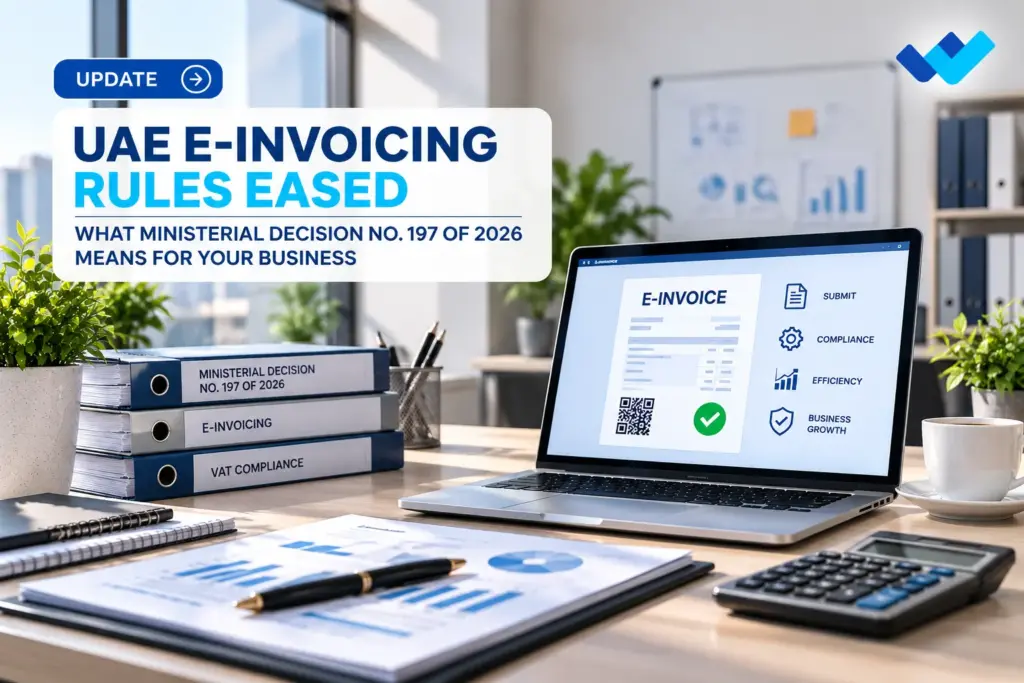
The UAE Ministry of Finance has relaxed several UAE e-invoicing rules ahead of the national rollout. Ministerial Decision No. 197 of 2026, effective 1 October 2026, gives VAT tax groups a 24-month break for transactions between group members, allows e-invoice records to be stored outside the UAE, moves the issuing deadline to 14 business days and removes the two-day system-failure notice.
The important part for most businesses: the go-live date has not moved. Large businesses must still be live on the UAE e-invoicing system from 1 January 2027, and the deadline to appoint an Accredited Service Provider (ASP) is 30 October 2026.
Below, our VAT team explains what changed, what stays the same, and the practical steps to take now.
Key takeaways
- Effective 1 October 2026 under Ministerial Decision No. 197 of 2026
- Intra-tax-group transactions excluded from 1 January 2027 to 31 December 2028
- E-invoice data may now be stored outside the UAE, but must still be kept and produced to the FTA on request
- Issuing deadline changed from 14 calendar days to 14 business days
- Go-live dates unchanged: 1 January 2027 for businesses with revenue of AED 50 million or more
What Changed Under Ministerial Decision No. 197 of 2026
Decision No. 197 amends Ministerial Decision No. 243 of 2025, the main regulation behind UAE e-invoicing. There are four changes.
1. 24-month relief for VAT tax groups
Transactions between members of the same VAT tax group are excluded from mandatory e-invoicing from 1 January 2027 to 31 December 2028. If two companies in one tax group invoice each other, those invoices do not need to go through the e-invoicing network during this period.
The relief is narrow. It covers only transactions between members of the same VAT tax group, not every related-party or intercompany transaction. Sales from a group member to an outside customer still need e-invoices from the group’s go-live date, and intra-group transactions come back into scope from 1 January 2029. If you are considering forming a group, our guide to UAE tax grouping explains how it works.
2. E-invoice records can now be stored outside the UAE
The earlier rule required e-invoice and credit note data to be stored in the UAE. That requirement has been removed. You must still keep e-invoices, e-credit notes and the related data for the period set by the Tax Procedures Law, and provide them to the Federal Tax Authority (FTA) on request.
Sector rules still apply. Banks and other regulated entities with their own data-residency requirements should check those before moving records abroad.
3. 14 business days to issue an e-invoice
The deadline to issue an e-invoice or e-credit note has changed from 14 calendar days to 14 business days from the date of the transaction.
If you are VAT-registered, keep working to the VAT Law timeline, which is generally 14 calendar days from the date of supply for tax invoices. The longer e-invoicing window mainly helps transactions that fall outside VAT timelines.
4. No more two-day system-failure notice
Businesses no longer have to notify the FTA within two business days when their e-invoicing system fails. Article 12 of the earlier decision has been repealed and the definition of “system failure” removed. Your ASP may still have its own reporting duties, so keep an internal record of any outage.
What Has Not Changed: UAE E-Invoicing Deadlines
The amendments do not postpone the rollout. The current timeline is:
| Business group | Appoint an ASP by | Go live on e-invoicing |
|---|---|---|
| Revenue of AED 50 million or more | 30 October 2026 | 1 January 2027 |
| Revenue below AED 50 million | 31 March 2027 | 1 July 2027 |
| Government entities (B2G) | 31 March 2027 | 1 October 2027 |
The AED 50 million test is based on annual revenue. A business that crossed the threshold in its last financial year is in the first group, even if the current year is quieter.
Who Must Comply With UAE E-Invoicing
- In scope: business-to-business (B2B) and business-to-government (B2G) invoices.
- Out of scope for now: business-to-consumer (B2C) sales to individuals.
- Both sides need an ASP: suppliers use an ASP to send e-invoices, and buyers use one to receive them.
- Format: invoices are exchanged as structured data in the UAE PINT AE standard over the Peppol network. A PDF or scanned invoice will no longer count as an e-invoice.
- How it works: the UAE uses a “five-corner” model. Your ASP validates and sends the invoice to the buyer’s ASP, and the tax data is reported to the FTA.
Penalties for Not Complying
Penalties are set by Cabinet Decision No. 106 of 2025:
- AED 5,000 per month (or part of a month) for failing to implement the e-invoicing system, including failing to appoint an ASP on time
- AED 100 per e-invoice not issued and transmitted on time, up to AED 5,000 per calendar month
- AED 100 per e-credit note not issued on time, up to AED 5,000 per calendar month
- AED 1,000 per day for failing to update registered data with the FTA
These sit alongside the existing VAT penalties. Our comparison of Cabinet Decision 108 of 2021 and 129 of 2025 covers the wider penalty regime.
What Your Business Should Do Now
- Confirm your group. Check your annual revenue against the AED 50 million threshold.
- Appoint an ASP. If you are in the first group, do it before 30 October 2026. Choose a provider from the Ministry of Finance’s accredited list.
- Map your tax group transactions. Identify which invoices fall under the 24-month exclusion and plan for 1 January 2029.
- Review your storage set-up. Decide where e-invoice data will be kept, and confirm you can produce it to the FTA on request.
- Clean your master data. Check customer TRNs, addresses and product codes; e-invoices are validated field by field.
- Test before go-live. Run test invoices with your ASP and train your finance team.
How Hussain Al Shemsi Chartered Accountants Can Help
As Chartered Accountants based in Sharjah, our team helps UAE businesses get e-invoicing ready. We assess your scope and timeline, help you choose and appoint an ASP, review your VAT and tax group position, and check your invoicing data before go-live. Learn more about our VAT services and accounting and MIS services.
Frequently Asked Questions
When does UAE e-invoicing start?
Businesses with annual revenue of AED 50 million or more go live on 1 January 2027. Businesses below that threshold go live on 1 July 2027, and government entities on 1 October 2027.
Has the UAE e-invoicing deadline been extended again?
No. Ministerial Decision No. 197 of 2026 eases some rules but does not change the go-live dates. The ASP appointment deadline for large businesses remains 30 October 2026.
Are transactions within a VAT tax group exempt from e-invoicing?
Yes, temporarily. Transactions between members of the same VAT tax group are excluded from 1 January 2027 to 31 December 2028. Sales to customers outside the group still need e-invoices.
Can e-invoices be stored outside the UAE?
Yes. The requirement to store e-invoice data in the UAE has been removed, but you must keep the records for the period set by the Tax Procedures Law and provide them to the FTA on request.
What is an Accredited Service Provider (ASP)?
An ASP is a provider accredited by the Ministry of Finance to send, receive and validate e-invoices over the Peppol network and report tax data to the FTA. Both suppliers and buyers need one.
What is the penalty for not appointing an ASP on time?
AED 5,000 for each month, or part of a month, of delay under Cabinet Decision No. 106 of 2025.
Does e-invoicing apply to B2C sales?
Not at this stage. The mandate covers B2B and B2G transactions. Sales to individual consumers are currently outside its scope.
Get Ready for UAE E-Invoicing
Not sure which group you fall into, or which ASP to choose? Our VAT team can review your position and help you prepare before your deadline.
Sources: UAE Ministry of Finance – eInvoicing; Federal Tax Authority; Gulf News, 19 October 2026. This article is general guidance; contact us for advice on your business.
How can we help you?
Get in touch with Hussain Al Shemsi Chartered Accountants for expert auditing, accounting, tax, and advisory services in the UAE.
- +971 50 3636231
Recent Posts
-
 UAE E-Invoicing Rules Eased: What Ministerial Decision No. 197 of 2026 Means for Your Business
-
 UAE Corporate Tax Deadline 2026: File by September 30
-
 UAE Small Business Relief Extended Until 31 December 2029
-
 FTA Directive No. 5 of 2026: VAT Deemed Supply Valuation | HASCA
-
 FTA Decision No. 6 of 2026: AUP Requirement for Free Zone Distributors
