


Trusted us by over 3,000 local businesses
MOHRE's Ministerial Resolution No. 340 of 2026 is now in force. This is the complete employer's guide to the new WPS deadline, the day-by-day penalty timeline, the 85% threshold, and exactly what to do before June salaries are due.
By Hussain Al Shemsi Chartered Accountants · June 2026 · 8 min read
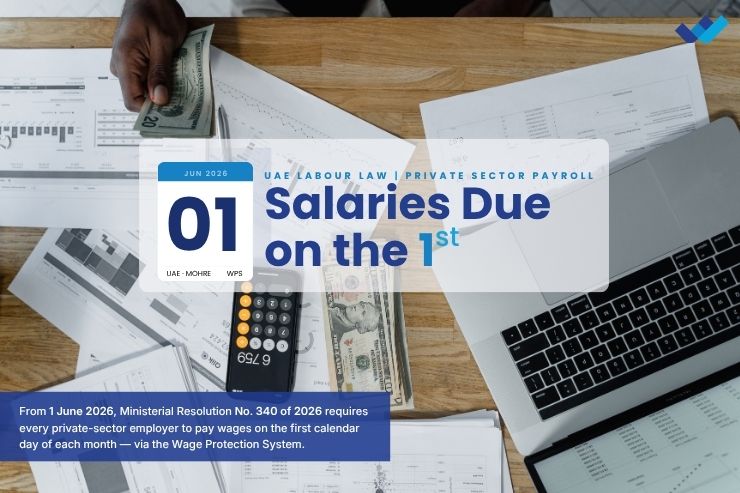
On 12 May 2026, the UAE Ministry of Human Resources and Emiratisation (MOHRE) issued Ministerial Resolution No. (0340) of 2026, introducing a single, unified salary deadline for all private-sector employers across the country. Effective 1 June 2026, every company registered with MOHRE must pay its employees' salaries on the 1st of every month — for the preceding month's work — through the Wage Protection System (WPS) or another MOHRE-approved payment channel.
This guide — prepared by Hussain Al Shemsi Chartered Accountants, one of the leading audit and accounting firms in Sharjah and the UAE — breaks down every aspect of the new rule: the exact penalty timeline, the 85% compliance threshold, exemptions, and the practical steps your business must take before the first salary cycle falls due.
Legal basis: Ministerial Resolution No. (0340) of 2026 Concerning the Wage Protection System, issued by the Minister of Human Resources and Emiratisation on 12 May 2026. The Resolution operates under Federal Decree-Law No. 33 of 2021 on the Regulation of Labour Relations and Cabinet Resolution No. 21 of 2020 (penalty framework).
Under Ministerial Resolution No. 340 of 2026, enforcement is automatic and compressed. Miss the 1st-of-month deadline and the chain begins within hours.
85% of total payroll must transfer on the 1st of every month. No grace period.
Electronic alerts sent. Logged permanently on your MOHRE compliance record.
All new permits, renewals and transfers suspended until wages are settled.
Administrative fines applied. Company downgraded to third MOHRE category.
MOHRE files a labour dispute on employees' behalf. Workers may transfer freely.
Case referred to Public Prosecution. Consequences include executive orders, asset freezing, and travel bans on the person in charge — statutory outcomes under Ministerial Resolution No. 340 of 2026.
The tightest payroll deadline MOHRE has ever set — the 1st of every month, no exceptions — means your entire payroll process must move earlier. Here is a concrete five-step checklist to ensure your business is never on the wrong side of this rule.
Move your payroll cut-off to the 25th — no later. This gives your WPS agent (bank or exchange house) five to six days to prepare, validate, and submit the Salary Information File (SIF) without errors or resubmission delays. If your current payroll process runs into the final week of the month, it must be redesigned immediately.
A single mismatch between any employee's SIF data and their MOHRE-registered employment contract — salary amount, allowances, deductions, or employee ID — can trigger a compliance flag and delay salary clearance. Assign a dedicated reviewer to validate every SIF before submission, not after. One rejected SIF on the 31st means delayed salaries on the 1st.
Verify compliance at two levels every cycle: (a) company level — at least 85% of all wages must clear WPS, and (b) individual level — no employee should receive less than 85% of their contracted salary without a documented, lawful reason. Build this dual-check into your monthly payroll checklist before final SIF submission.
Unpaid leave, authorised absence, approved salary deductions — all must be documented in advance with formal employee acknowledgement and MOHRE notification where required. An undocumented salary shortfall — even a legitimate one — is indistinguishable from non-payment in MOHRE's automated system and will trigger a compliance alert.
Under Ministerial Resolution No. 340 of 2026, the person in charge of the establishment can personally face travel bans and asset freezing if prosecution is reached. Payroll compliance is now a board-level concern, not just an HR function. Assign a designated owner, set calendar alerts for the 25th-of-month cutoff, and consider engaging an independent accounting firm for external oversight.
As one of the best chartered accounting and audit firms in Sharjah and the UAE, we provide end-to-end payroll compliance support: WPS process reviews, SIF accuracy audits, MOHRE compliance advisory, and financial controls setup — so your business is fully protected under the new June 2026 rules. We are FTA-registered, IFRS-compliant, and serve businesses across Sharjah, Dubai, and the wider UAE. Book a free consultation →
Under Ministerial Resolution No. (0340) of 2026, all private-sector employers registered with MOHRE must pay employee salaries on the 1st of every month — for the preceding month's work — via the Wage Protection System (WPS) or another MOHRE-approved payment channel. Any payment after the 1st is officially classified as a delayed salary transfer. The rule took effect on 1 June 2026.
A company is considered compliant if it transfers at least 85% of total wages by the 1st-of-month deadline, and if each individual employee receives at least 85% of their contractual salary. Any shortfall below 85% — at either the company or individual level — must be backed by documented, lawful deductions. This is stricter than the previous 80% benchmark that applied under earlier WPS rules.
The escalation begins on Day 2 with a formal MOHRE electronic warning. By Day 5, new work permits are frozen. On Day 11, administrative fines under Cabinet Resolution No. 21/2020 are applied and the company is downgraded to the third MOHRE category. On Day 16, MOHRE automatically files a labour dispute on behalf of employees. By Day 21, the matter is referred to the Public Prosecution — with the risk of asset freezing and travel bans on the person in charge.
Yes. Ministerial Resolution No. 340 of 2026 explicitly provides that if non-payment reaches Day 21, the matter is referred to the Public Prosecution. Consequences at this stage can include executive orders, asset freezing, and travel bans on the person in charge of the establishment. This applies particularly to companies employing 50 or more workers in persistent violation.
Ministerial Resolution No. (0340) of 2026 Concerning the Wage Protection System is the MOHRE directive issued on 12 May 2026. It introduces a unified 1st-of-month salary deadline for UAE private-sector employers, the 85% compliance threshold, a compressed penalty timeline starting on Day 2, and updated exemption categories. It operates under Federal Decree-Law No. 33 of 2021 on the Regulation of Labour Relations, and Cabinet Resolution No. 21 of 2020 for penalties.
Ministerial Resolution No. 340 of 2026 directly governs all MOHRE-registered private-sector establishments on the UAE mainland. Free Zone companies should verify their specific obligations with their respective Free Zone Authority — however, several major free zones including JAFZA, DMCC, and SAIF Zone operate WPS-aligned payroll compliance frameworks. Contact our team for a confidential assessment of your company's obligations.
Yes. Ministerial Resolution No. 340 of 2026 explicitly allows companies to authorise third-party providers to manage WPS salary processing on their behalf. However, legal responsibility for timely wage payment remains with the employer at all times. Delegating payroll processing to a third party does not transfer liability — the company and its person in charge remain fully accountable for compliance.
We provide WPS compliance audits, payroll process reviews, SIF accuracy checks, MOHRE advisory services, and financial controls implementation for businesses across Sharjah, Dubai, and the UAE. As one of the best audit and chartered accounting firms in the UAE — FTA-registered and IFRS-compliant — we ensure your payroll framework meets every requirement under Ministerial Resolution No. 340 of 2026. Call +971 50 363 6231 or visit hussainalshemsi.ae.
Hussain Al Shemsi Chartered Accountants
One missed cycle is enough to trigger the chain — from MOHRE warning to work-permit freeze to prosecution. Our team reviews your WPS process, closes every compliance gap, and ensures your payroll is fully protected before the deadline hits.
hussainalshemsi.ae · Sharjah, UAE · FTA Registered · IFRS Compliant · UAE Free Zone Approved Auditor
Get in touch with Hussain Al Shemsi Chartered Accountants for expert auditing, accounting, tax, and advisory services in the UAE.





Hussain Al Shemsi Chartered Accountants is a full-service professional chartered accountant firm, licensed by the Ministry of Economy, United Arab Emirates, to practice auditing and accounting.
Buhaira Insurance Tower, #402, 4th Floor, Opp. Al Noor Mosque, Al Majaz 1, Sharjah, UAE
PO Box: 3950© 2026 Hussain Al Shemsi. All rights reserved. Designed
WhatsApp us
